



FREE with reservations
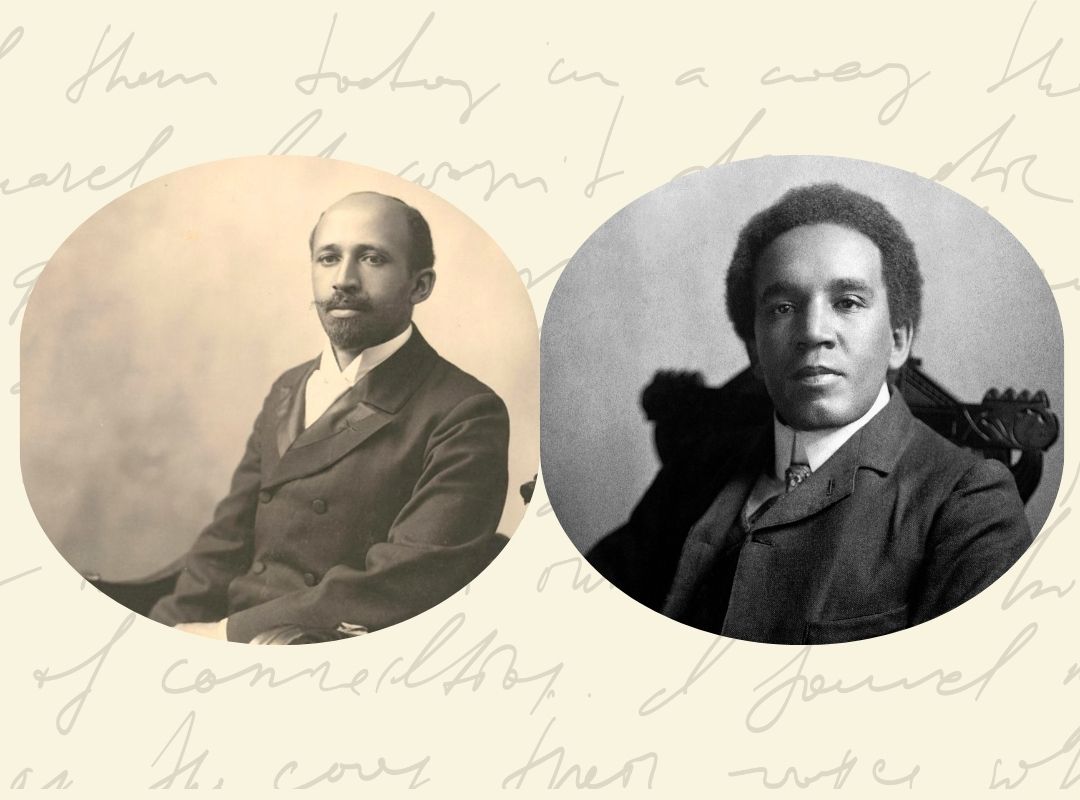
The W. E. B. Du Bois Center at UMass Amherst and The Du Bois Freedom Center Present a special evening celebrating the lives, works, and friendship of American scholar-activist W. E. B. Du Bois and the British composer, Samuel Coleridge-Taylor. The two first met in 1900 at the first Pan-African Conference in London and shared a bond centered on the celebration of Black history, culture, and identity. They forged a firm friendship which lasted until Coleridge-Taylor’s untimely death in 1912. The event will begin with a group reading of ‘The Immortal Child’ from W. E. B. Du Bois’, Darkwater (1920), which he penned in memory and tribute to his late friend.
This reading will be followed by a performance of Samuel Coleridge-Taylor’s Clarinet Quintet in F-sharp Minor, which displays both his virtuosity as a performer and his adoption of musical motifs and ideas from the African Diaspora. Our evening will conclude with an opportunity for audience members to engage in questions and conversation with the musicians and representatives from both the W. E. B. Du Bois Center at UMass Amherst and the Du Bois Freedom Center.
MUSIC PERFORMANCE:
Clarinet Quintet in F-sharp Minor, Op. 10 / Samuel Coleridge-Taylor (1895)
I. Allegro energico
II. Larghetto affettuoso
III. Scherzo. Allegro leggiero
IV. Finale. Allegro agitato
MUSICIANS:
Hannah Berube – Clarinet
Hannah Collins – Cello
Clara Lyon – Violin
Hyobi Sim – Violin
Elijah Wilson – Violin
Featured musicians come with experience from the Lydian String Quartet, St. Paul Chamber Orchestra, New England Repertory Orchestra, and A Far Cry.
W.E. B. Du Bois (1868 – 1963) Born in Great Barrington, Massachusetts three years after the end of the American Civil War, William Edward Burghardt Du Bois rose to prominence initially as a scholar and then as an international leader in the fight for social justice and racial equality. Du Bois gained his undergraduate degree from Fisk University before becoming the first Black man to gain a PhD from Harvard University.
His early work in the emerging science of sociology helped establish this discipline in American academia and brought Du Bois to Atlanta University in the 1890s. It was here, however, that Du Bois once again encountered the violent racism of the American South which brought the realization that scholarship alone would not be enough – he must become a public intellectual leader as well. In 1903 Du Bois published the sensational volume of essays, The Souls of Black Folk, which remains a classic of American literary depictions of Black life in America. He helped found the Niagara movement in 1905 and the National Association for the Advancement of Colored People (NAACP) in 1909. He was the editor of the NAACP’s mouthpiece, The Crisis, for almost a quarter of a century.
Du Bois travelled the world advocating for the rights of the oppressed everywhere. He helped convene the Pan-African Congresses following the First World War and he was active in the struggle for peace during the Cold War. He died in 1963 in Accra, capital of the newly-independent Ghana. Throughout his long life, Du Bois never stopped producing writing and scholarship that continues to inform and inspire in equal measure long after his passing. The University of Massachusetts Amherst are proud to be the custodians of Du Bois’s archival papers which reside in the Robert S. Cox Special Collections & University Archives Research Center.
Samuel Coleridge-Taylor (1875-1912) Born in Holborn, Central London, in 1875 to an English mother and a father who originally came from Sierra Leone, Samuel Coleridge-Taylor rose to fame as a composer in his early twenties. One of his most notable pieces from his early career was Hiawatha’s Wedding Feast, which he debuted in 1898. His influences were many, but included traditional African music and Coleridge-Taylor took great pride in his own African heritage. In 1900 he participated in the First Pan-African Conference, held in London, as the youngest delegate. It was here that he met, and formed a friendship with, W. E. B. Du Bois.
Samuel Coleridge-Taylor wrote the Clarinet Quintet in response to a remark by his composition professor that it would be impossible to write a piece for the instrumentation that was not influenced by Johannes Brahms’ monumental Clarinet Quintet. In 1895 while still a student at the Royal Academy of Music, Coleridge-Taylor rose to the challenge, creating a work using a highly skilled and daring treatment of the instrumentation that drew upon his own rich musical heritage. The first documented 17 performances of Coleridge-Taylor’s Clarinet Quintet in the United States occurred in 1906 on his second US tour. Members of the Boston Symphony Orchestra performed the work on a program alongside selections from his Op. 57 Sorrow Songs and Op. 59 Twenty-four Negro Melodies. Coleridge-Taylor accompanied the great Black American composer and baritone Harry Burleigh, who had famously succeeded in bringing spirituals to the American classical music stage. Notably, Coleridge-Taylor donated proceeds from this performance to Atlanta University, where W. E. B. Du Bois was teaching.